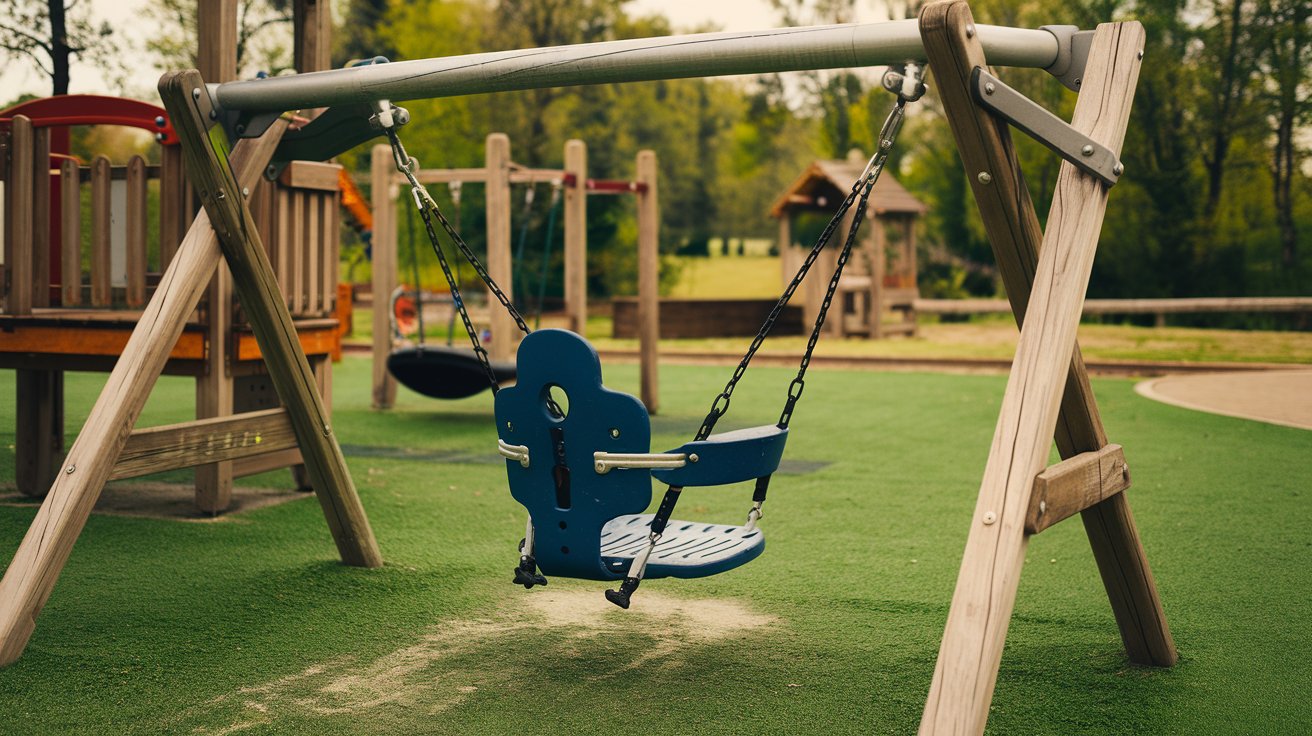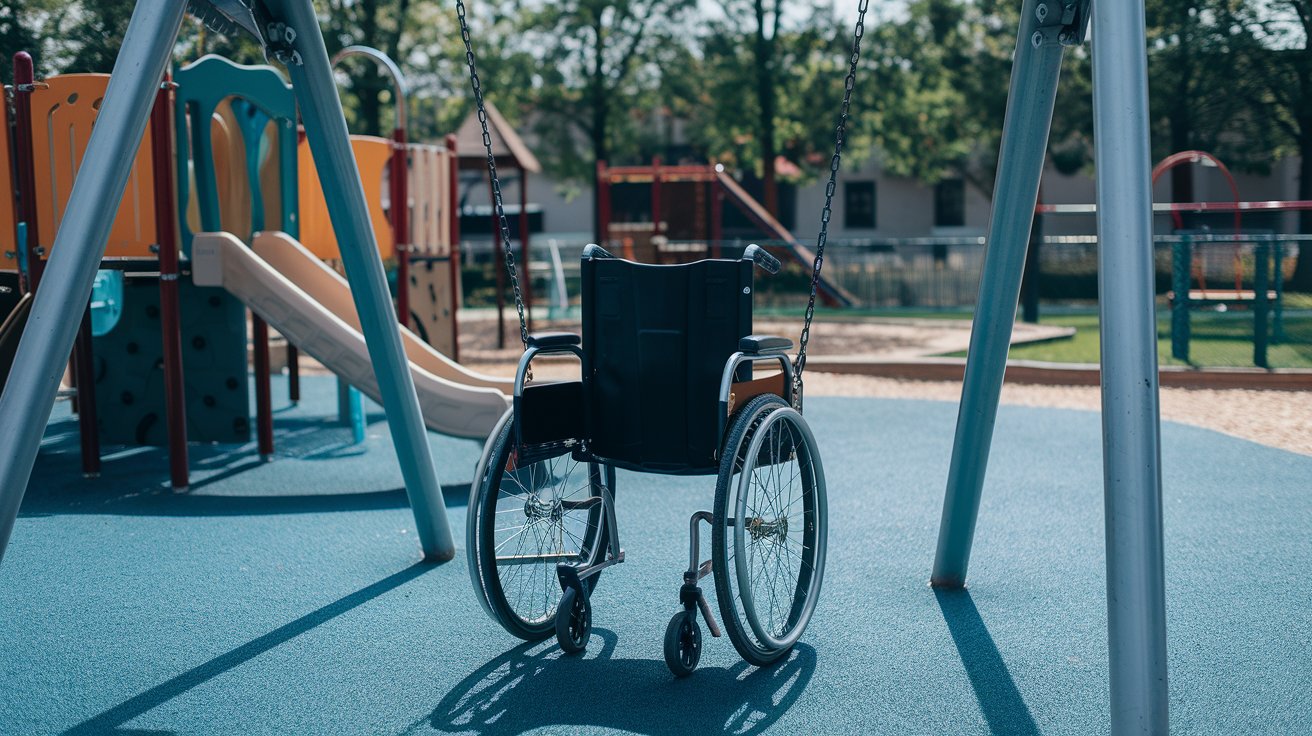
A wheelchair swing for playground is an essential piece of adaptive equipment that provides children with mobility challenges the opportunity to experience the joy of swinging. These ADA-compliant accessible swings are designed to accommodate wheelchairs or support children who cannot use standard playground equipment. In 2026, approximately 2.8 million children in the United States have mobility impairments, making accessible playground equipment more important than ever for creating inclusive community spaces.
What Is a Wheelchair Swing for Playgrounds
A wheelchair swing is a specialized playground apparatus designed to accommodate children who use mobility devices or require additional postural support. Unlike traditional swings, these adaptive swing seats feature platforms or harness systems that can secure a wheelchair or provide full-body support for children with limited trunk control. The swing platform typically measures between 30 to 48 inches in diameter and can support weights ranging from 300 to 800 pounds, depending on the model.
Modern playground wheelchair swings incorporate advanced safety features including high-backed seats, multiple harness points, and shock-absorbing suspension systems. The design allows caregivers to easily transfer children into the swing or roll wheelchairs directly onto the platform. These swings meet ADA accessibility standards and ASTM F1487 safety specifications, which were updated in 2024 to include enhanced inclusive play requirements that take effect fully in 2026 across all federally funded playground projects.
Types of Wheelchair Accessible Swings
Understanding the different types of accessible playground swings helps communities select the best option for their needs and budget. Each type serves specific accessibility requirements and playground configurations.
Platform Wheelchair Swings
Platform wheelchair swings feature a large, flat surface that accommodates a wheelchair directly on the swing platform. These designs typically include raised edges or rails to prevent the wheelchair from rolling off during motion. The platform size ranges from 36 to 60 inches, with commercial-grade models supporting up to 1,000 pounds. Installation requires a single bay swing frame with reinforced support chains rated for increased weight capacity. Platform swings retail between $3,200 and $8,500 in 2026, with installation costs adding another $1,500 to $3,000 depending on site preparation needs.
Full-Support Harness Swings
Adaptive swing seats with replacement harnesses provide comprehensive postural support for children who cannot sit independently. These swings feature padded bucket seats with adjustable five-point harness systems, head support, and pommel positioning devices. The harness swing design distributes weight evenly and prevents sliding, making them ideal for children with cerebral palsy, spinal cord injuries, or severe developmental delays. Models manufactured in 2026 incorporate antimicrobial coating materials and UV-resistant fabrics that extend service life to 8-10 years. Prices range from $850 to $2,400 for the seat assembly, with installation hardware included.
Transfer Platform Swings
Transfer platform swings offer a middle-ground solution where children transfer from their wheelchair onto a supportive swing seat at ground level. These systems include transfer platforms adjacent to the swing with handrails and non-slip surfaces. The design promotes independence for children with partial mobility while providing adequate support during the swinging experience. Transfer swings cost between $2,100 and $4,800 and require less robust frame construction than full wheelchair platform swings, reducing overall installation expenses.
ADA Compliance Requirements for Wheelchair Swings
ADA wheelchair swing requirements mandate specific accessibility features to ensure inclusive playground design. The 2010 ADA Standards for Accessible Design, supplemented by the 2024 accessibility updates, require that playgrounds serving populations over 1,000 people include at least one wheelchair-accessible swing. The swing must be located on an accessible route with a firm, stable surface that connects to parking areas, sidewalks, and other playground elements.
Ground surface requirements specify that the access path and use zone must consist of materials with a vertical drop of no more than 0.5 inches and a running slope not exceeding 1:16. Engineered wood fiber, poured-in-place rubber, and rubber tiles meeting ASTM F1951 accessibility standards are approved surfacing materials. The clear floor space around the swing must measure at least 60 by 60 inches to accommodate wheelchair positioning for transfers. In 2026, approximately 68% of U.S. public playgrounds meet full ADA compliance, up from 52% in 2020.
Safety Standards and Certifications
ASTM F1487 safety standards govern all playground equipment, including wheelchair swings, with specific provisions for accessible equipment added in recent updates. Manufacturers must demonstrate that swing components withstand dynamic load testing at 150% of the rated capacity. Chain systems require protective coatings to prevent pinching, and all edges must be rounded to eliminate injury hazards. The standards mandate maximum swing arc measurements to prevent collisions with support structures.
Certified playground wheelchair swings display compliance markings from testing laboratories such as TÜV SÜD, SGS, or Intertek. Products must include documentation showing compliance with CPSC Handbook for Public Playground Safety volume II, which specifically addresses accessible equipment. In 2026, equipment manufactured without third-party certification faces increased liability exposure, with legal settlements averaging $340,000 for playground injury cases involving non-compliant accessible equipment. Municipalities and schools should verify that any wheelchair swing purchase includes complete safety certification documentation and installation guidelines from ASTM-certified playground safety inspectors.
Installation Requirements and Site Preparation
Proper installation of a wheelchair swing for playground requires professional assessment and preparation to ensure safety and longevity. Site evaluation begins with soil testing to determine ground composition and drainage characteristics. Clay-heavy soils require additional excavation and gravel base installation to prevent frost heaving in northern climates. The swing bay footprint typically extends 20 feet in length and 14 feet in width to accommodate use zones specified by CPSC guidelines.
Foundation work involves setting concrete footings at depths below the frost line, ranging from 30 inches in southern states to 48 inches in Minnesota and North Dakota. Each footing must cure for a minimum of seven days before frame installation begins. The swing frame structure requires galvanized steel posts with minimum 3.5-inch outer diameter and 0.25-inch wall thickness to support increased loads. Professional installation teams complete typical wheelchair swing installations in 3-5 days, with costs ranging from $8,500 to $18,000 for turnkey projects including equipment, surfacing, and accessible pathways.
Choosing the Right Wheelchair Swing Model
Selecting the optimal accessible swing equipment depends on user demographics, budget constraints, and playground design objectives. Communities serving predominantly younger children ages 2-5 typically benefit most from full-support harness swings that accommodate various developmental needs. Elementary school playgrounds serving ages 5-12 often install combination systems with both platform and transfer options to serve diverse mobility levels.
Weight capacity represents a critical selection factor, with standard models supporting 300-500 pounds and heavy-duty commercial systems rated to 1,000 pounds. Higher capacity swings cost 40-60% more but provide longer service life in high-traffic locations. Material selection impacts durability and maintenance requirements, with powder-coated galvanized steel frames offering 15-20 year service life compared to 8-12 years for painted carbon steel. In 2026, approximately 73% of newly installed playground wheelchair swings feature stainless steel chain systems that eliminate rust concerns and reduce annual maintenance costs by an estimated $200-400 per swing.
Top Wheelchair Swing Manufacturers
The accessible playground equipment market includes several established manufacturers known for quality wheelchair swing systems. Each offers distinct advantages in design, warranty coverage, and pricing structures.
Landscape Structures and GameTime
Landscape Structures leads the commercial playground market with its We-Go-Round and Sway Fun wheelchair-accessible swing models. Their equipment features proprietary Rhino-Hide coating that resists vandalism and weathering in harsh climates. The company offers 15-year limited warranties on structural components and maintains the industry’s most extensive parts availability program. GameTime manufactures the popular Therapy Swing and Express 200 platform swing, with installations in over 4,500 U.S. school districts. Both manufacturers provide design assistance and CAD drawings for integrated playground planning at no additional cost.
Kompan and PlayCore Brands
Kompan’s Comet wheelchair swing incorporates patented suspension technology that provides smoother motion profiles compared to traditional chain systems. The Danish manufacturer emphasizes European safety standards that often exceed U.S. requirements. PlayCore brands including Soft Play and Playworld offer modular accessible swing systems that allow communities to start with basic installations and add features over time. Their financing programs help municipalities spread costs over 3-5 year periods, with 72% of public park departments utilizing equipment financing in 2026 according to National Recreation and Park Association data.
Cost Analysis and Funding Options
The total investment for a wheelchair accessible swing installation includes equipment costs, site preparation, surfacing materials, and ongoing maintenance expenses. Entry-level harness swings start at $850, while complete platform wheelchair swing systems with installation range from $12,000 to $25,000. These figures reflect 2026 pricing with approximately 8% increases over 2024 levels due to steel tariffs and labor cost inflation.
Multiple funding sources help communities afford ADA playground equipment upgrades. The Community Development Block Grant program allocates $3.4 billion annually for public facility improvements, with playgrounds qualifying under accessibility mandates. The Land and Water Conservation Fund provides matching grants up to $75,000 for playground projects that demonstrate community need. Private foundation funding through organizations like GameTime’s More Than a Game Foundation, KaBOOM!, and local community foundations contributed over $47 million to accessible playground construction in 2025. Many municipalities successfully combine funding sources, using 40% grant funding, 35% municipal capital budgets, and 25% community fundraising to complete projects.
Maintenance and Inspection Protocols
Routine maintenance extends the service life of wheelchair playground swings and prevents safety hazards that could result in injuries or liability claims. Daily visual inspections should identify obvious hazards such as vandalism damage, surface contamination, or broken components. Weekly inspections documented on standardized checklists examine chain wear, bearing function, and seat condition. Trained playground safety inspectors conduct monthly functional inspections testing weight distribution, swing arc clearances, and surfacing depth measurements.
Annual comprehensive inspections performed by Certified Playground Safety Inspectors (CPSI) document compliance with ASTM standards and identify needed repairs or replacements. Common maintenance tasks include lubricating bearing assemblies quarterly, replacing worn chains every 3-4 years, and refreshing protective coatings every 5-7 years. Proper maintenance programs cost approximately $350-600 annually per wheelchair swing, significantly less than the $15,000-80,000 expense of unplanned equipment replacement due to neglect. In 2026, digital maintenance tracking systems using QR codes and cloud-based platforms help park departments manage inspection schedules across multiple facilities, improving compliance rates by 34% compared to paper-based systems.
Benefits of Inclusive Playground Design
Installing wheelchair swings creates measurable social, developmental, and community benefits beyond basic accessibility compliance. Research from the Center for Inclusive Design and Innovation shows that children using accessible playgrounds demonstrate 28% higher rates of social interaction compared to segregated adaptive play facilities. Inclusive design reduces stigma by integrating children with disabilities into mainstream recreational activities, promoting empathy and understanding among typically developing peers.
The physical and therapeutic benefits of swinging include vestibular system stimulation that improves balance, coordination, and spatial awareness. Occupational therapists incorporate adaptive swing activities into treatment plans for children with sensory processing disorders, autism spectrum disorder, and developmental coordination disorder. Community playgrounds with wheelchair-accessible swings experience 15-20% higher overall usage rates according to 2025 National Recreation and Park Association surveys. Property values within quarter-mile radius of accessible playgrounds show 3-5% premiums compared to similar neighborhoods with standard playgrounds, demonstrating tangible economic benefits of inclusive design investments.
Common Installation Mistakes to Avoid
Even experienced contractors make errors during wheelchair swing installation that compromise safety and functionality. The most frequent mistake involves inadequate use zone planning, with swing arcs intersecting sidewalks, benches, or other playground equipment. CPSC guidelines require use zones extending twice the height of the pivot point in all directions, typically creating a 30-40 foot diameter clear zone around wheelchair swings.
Improper surfacing installation represents another critical failure point, with many installations using insufficient depth of engineered wood fiber or skipping required geotextile underlayment. The accessible surface pathway must maintain firm, stable characteristics throughout its life, requiring different design approaches than loose-fill materials used in general play areas. Foundation depth errors cause swing structures to shift or heave, creating safety hazards and voiding manufacturer warranties. In cold climates, footings must extend below frost line depths that vary from 30 inches in Tennessee to 60 inches in northern Minnesota. Using unqualified installers saves 15-25% on initial costs but increases long-term expenses through premature equipment failure and potential liability exposure exceeding $500,000 in serious injury cases.
Related video about wheelchair swing for playground
This video complements the article information with a practical visual demonstration.
Key Questions and Answers
How much weight can a wheelchair swing hold?
Most commercial wheelchair swings have weight capacities ranging from 300 to 800 pounds, with heavy-duty models supporting up to 1,000 pounds. Platform-style swings designed to accommodate wheelchairs directly typically offer higher capacity ratings between 600-1,000 pounds to support the combined weight of the user, wheelchair, and caregiver during transfer. Standard adaptive harness swings generally support 300-500 pounds. Always verify the manufacturer’s rated capacity and ensure it exceeds your expected maximum user weight by at least 100 pounds for safety margin. In 2026, models with 750+ pound capacities have become standard for most public playground installations to accommodate adult-sized wheelchairs and ensure long-term usability.
Are wheelchair swings required by ADA regulations?
The ADA requires wheelchair-accessible swings in specific circumstances based on playground size and population served. Playgrounds with more than 20 elevated play components or serving populations exceeding 1,000 people must include at least one wheelchair-accessible swing. Smaller playgrounds are not explicitly required to have wheelchair swings but must ensure that a variety of ground-level play experiences are accessible. The 2010 ADA Standards for Accessible Design and 2024 accessibility guidelines specify that when swings are provided, accessible swing options must be integrated into the playground design rather than segregated. Federally funded playground projects must demonstrate compliance with these standards, and many states have adopted additional requirements that exceed federal minimums for public park facilities.
What is the cost difference between regular and wheelchair swings?
A wheelchair swing costs significantly more than standard playground swings due to enhanced structural requirements and specialized design. Basic harness-style accessible swings retail for $850-2,400 compared to $150-400 for standard belt swings. Platform wheelchair swings range from $3,200-8,500 for equipment only, while complete installations including frame, surfacing, and accessible pathways total $12,000-25,000. Standard swing bay installations typically cost $3,500-7,000. The price premium reflects heavier-duty frame construction, increased weight capacity requirements, specialized seating systems, and more robust chain assemblies. Despite higher initial costs, wheelchair swings provide essential accessibility and typically last 15-20 years with proper maintenance, making them cost-effective investments for inclusive playground design that serves entire communities.
How do you transfer a child into a wheelchair swing?
Transfer procedures for wheelchair swings vary by swing design but follow general safety protocols. For platform-style swings, caregivers wheel the child directly onto the platform, engage wheel locks, and secure safety restraints if provided. Transfer-platform designs require positioning the wheelchair adjacent to the swing seat, applying wheelchair brakes, and assisting the child in sliding laterally onto the seat while maintaining trunk support. Harness swings require lifting or supporting the child during transfer from wheelchair to seat, then securing the multi-point harness system. Always ensure one caregiver maintains contact with the child throughout the transfer process. Many accessible swings installed in 2026 include transfer platforms at seat height with grab bars to promote independent transfers for children with partial mobility. Occupational therapists can provide family-specific transfer training to ensure safety and build child confidence during playground activities.
What surfacing is required under wheelchair swings?
Surfacing under wheelchair playground swings must meet both fall height protection and accessibility requirements. The surface must provide adequate impact attenuation based on the maximum fall height, typically requiring materials tested to ASTM F1292 standards. Simultaneously, the surface must maintain firm, stable characteristics meeting ASTM F1951 accessibility standards with less than 0.5-inch vertical drop and slopes not exceeding 1:16. Poured-in-place rubber surfacing offers optimal performance for both requirements, though it costs $15-25 per square foot installed. Bonded rubber tiles provide similar benefits at $12-18 per square foot. Engineered wood fiber can meet both standards when properly installed with geotextile fabric underlayment and maintained at 9-12 inch depth, costing $3-6 per square foot. The accessible route to the swing and immediate use zone require the highest-quality surfacing materials to prevent wheelchair entrapment and ensure safe access.
How long does a wheelchair swing last?
A properly maintained wheelchair swing typically lasts 15-20 years before requiring complete replacement, though individual components need periodic replacement throughout the service life. Galvanized steel frames with powder-coat finishes endure 15-20 years in most climates, while painted carbon steel frames last 8-12 years. Chains require replacement every 3-5 years depending on usage intensity and maintenance practices. Seat assemblies and harnesses last 5-8 years with regular inspection and replacement of worn straps or buckles. Bearings and bushings need replacement every 5-7 years. High-quality commercial playground swings from established manufacturers installed in 2026 incorporate improved materials including stainless steel chains and UV-resistant seat materials that extend component life 20-30% compared to equipment manufactured before 2020. Annual maintenance costs of $350-600 significantly extend total service life and prevent premature failure due to deferred maintenance.
| Key Aspect | Important Details | Benefit |
|---|---|---|
| Weight Capacity | 300-1,000 lbs depending on model; platform swings offer highest capacity | Accommodates various wheelchair sizes and ensures safety for all users |
| ADA Compliance | Required for playgrounds serving 1,000+ people; must include accessible route | Legal compliance and inclusive community access for children with disabilities |
| Installation Cost | $12,000-$25,000 complete turnkey including surfacing and pathways | Professional installation ensures safety, longevity, and warranty protection |
| Swing Types | Platform, harness, and transfer models serve different accessibility needs | Customizable solutions for diverse mobility requirements and age groups |
| Service Life | 15-20 years with proper maintenance; component replacement every 3-8 years | Long-term value and reduced lifecycle costs with regular inspection programs |
| Safety Standards | ASTM F1487 and CPSC compliance with third-party certification required | Reduced liability exposure and confidence in equipment safety performance |