
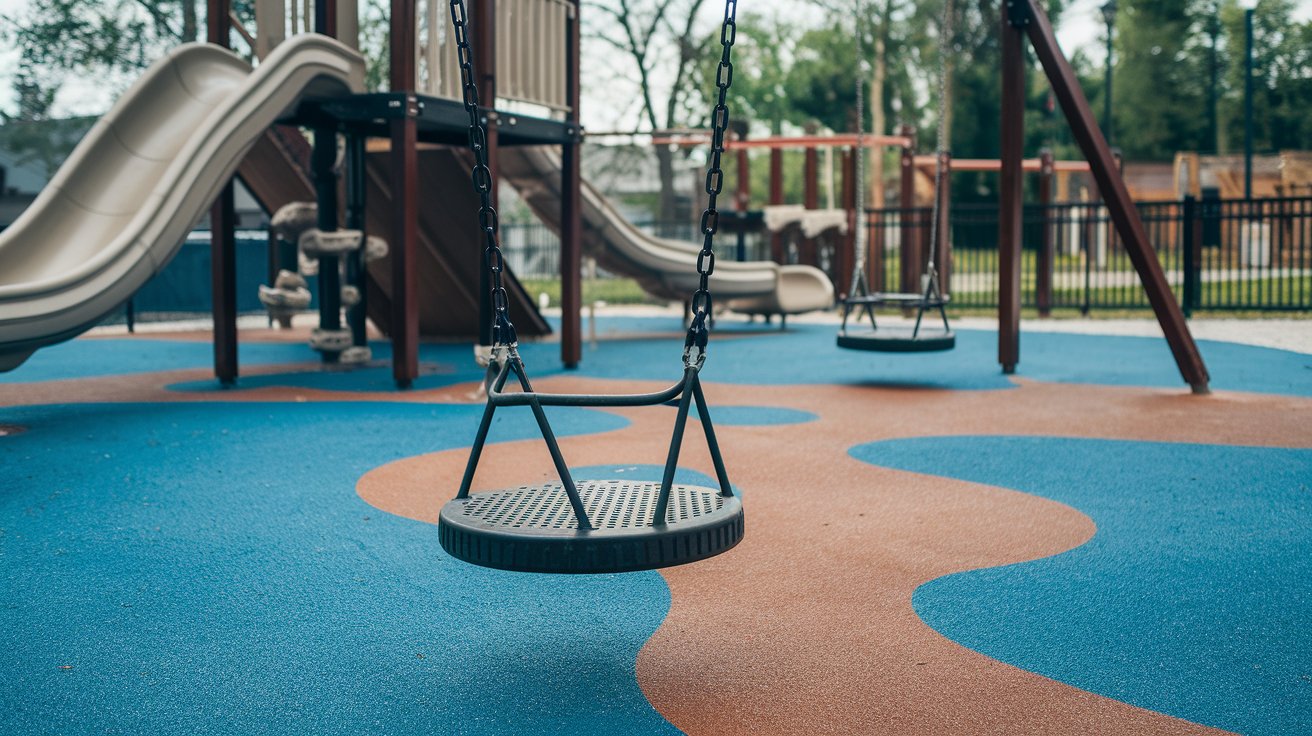
Creating ADA compliant playground surfaces is essential for public, school, and community play areas across the United States. Since the Americans with Disabilities Act requires accessible routes and surfaces that accommodate children and adults with mobility devices, choosing the right playground surfacing material ensures legal compliance while promoting inclusive play. This comprehensive guide covers material options, federal requirements, cost considerations, and safety standards updated for 2026 to help facility managers and decision-makers create truly accessible playgrounds.
What Are ADA Accessible Playground Surfaces?
ADA accessible playground surfaces are specialized materials that meet specific firmness, stability, and accessibility standards outlined in the Americans with Disabilities Act Accessibility Guidelines. These surfaces must provide wheelchair users, children with mobility devices, and individuals using crutches or walkers a stable, continuous path to and throughout the playground equipment. The 2010 ADA Standards for Accessible Design and ASTM F1951 testing protocols establish the technical requirements that playground surfaces must meet to qualify as accessible.
The primary requirement for accessible playground surfaces is maintaining an accessible route with a firm and stable surface that connects all playground components. This means the surfacing material cannot shift, compress excessively, or create barriers when someone using a wheelchair or mobility device travels across it. According to 2026 compliance data from the Access Board, approximately 68% of newly constructed playgrounds in the United States now incorporate fully compliant accessible surfacing, up from just 41% in 2020.
Federal ADA Playground Surface Requirements
The ADA playground requirements established by the Access Board specify that playground surfaces must meet impact attenuation standards while simultaneously providing accessibility. Section 1008.2.6 of the 2010 ADA Standards requires that ground-level accessible routes within the playground use zone have a surface compliant with ASTM F1951, which measures wheelchair maneuverability using a rotational force test and straight-ahead propulsion test.
Surfaces must achieve a work-per-foot value not exceeding 204 pounds of force during the straight propulsion test and less than 309 pounds of torque during the rotation test. Additionally, playground surfaces must meet ASTM F1292 standards for impact attenuation to protect children from fall-related injuries. The critical fall height rating must equal or exceed the maximum height of playground equipment accessible from that surface. As of 2026, federal inspectors report that inadequate playground surfacing represents the third most common ADA violation in public recreational facilities across the United States.
Types of ADA Compliant Playground Surfaces
Several surfacing materials can achieve ADA compliance when properly installed and maintained, each offering distinct advantages for different playground environments and budgets.
Poured-in-Place Rubber Surfacing
Poured-in-place rubber surfacing remains the gold standard for ADA compliance in 2026, consisting of a shock-absorbing base layer topped with a colored EPDM rubber wear layer. This seamless surface provides excellent accessibility because it creates no gaps, shifts, or displacement concerns. Installation involves mixing rubber granules with polyurethane binder and pouring the mixture directly onto a prepared base, typically over compacted aggregate or concrete. The resulting surface passes ASTM F1951 testing when properly installed at appropriate thickness levels, generally 2.5 to 6 inches depending on fall height requirements.
The cost of poured-in-place surfaces ranges from $12 to $25 per square foot installed in the United States during 2026, making it a premium investment. However, this surface type offers 10-15 year lifespan expectations with minimal maintenance, customizable colors and designs, superior drainage properties, and consistent accessibility regardless of weather conditions. Major municipalities including Seattle, Austin, and Charlotte have mandated poured-in-place surfacing for all new playground installations in their 2025-2026 park improvement projects.
Rubber Tiles and Mats
Rubber playground tiles provide another effective ADA compliant option, offering modular installation that facility managers can complete without specialized equipment. These interlocking tiles, typically measuring 2×2 feet or similar dimensions, feature built-in connector systems that create stable surfaces when installed over firm, level substrates. Quality rubber tiles manufactured specifically for playground use meet both ASTM F1951 accessibility standards and ASTM F1292 impact attenuation requirements when installed according to manufacturer specifications.
The advantages of rubber tile surfaces include easier repairs since damaged tiles can be individually replaced, lower initial installation costs ranging from $8 to $18 per square foot, and DIY-friendly installation for smaller playground areas. However, tile systems require proper sub-base preparation and regular inspection to ensure connectors remain secure and surfaces stay level. In 2026, approximately 28% of school playgrounds nationwide utilize rubber tile systems as their primary accessible surfacing solution, according to the National Recreation and Park Association.
Engineered Wood Fiber
Engineered wood fiber represents the most cost-effective ADA compliant surface option when properly maintained, consisting of specially processed wood pieces that compact to create a relatively firm, stable surface. Unlike traditional wood chips or mulch, engineered wood fiber undergoes precise manufacturing to create uniform particle sizes that interlock effectively. When installed at 9-12 inches depth over a firm base and maintained through regular grooming and top-dressing, this material can meet ASTM F1951 accessibility standards along designated accessible routes.
The primary challenge with wood fiber surfaces involves ongoing maintenance requirements. These surfaces need weekly inspection and grooming, quarterly depth measurements, and annual replenishment to maintain compliance. Moisture, freeze-thaw cycles, and decomposition constantly affect performance characteristics. Installation costs range from $4 to $9 per square foot in 2026, making engineered wood fiber attractive for large playground areas with limited budgets. However, lifecycle costs may exceed other options due to replacement needs every 3-5 years and intensive maintenance labor.
Bonded Rubber Mulch
Bonded rubber mulch combines recycled rubber particles with polyurethane binders similar to poured-in-place systems but maintains a textured appearance rather than smooth finish. This surface type offers middle-ground performance between loose-fill materials and seamless rubber surfaces, providing better accessibility than traditional loose materials while costing less than poured-in-place options. When professionally installed, bonded rubber mulch creates a porous, impact-absorbing surface that meets both safety and accessibility requirements.
In 2026, bonded rubber surfaces cost approximately $9 to $16 per square foot installed, with expected lifespans of 8-12 years. The material permits water infiltration while maintaining structural integrity, making it suitable for regions with heavy rainfall. Installation requires professional contractors with specialized equipment to achieve proper density and bonding throughout the surface. Performance testing shows that properly installed bonded rubber consistently meets ASTM F1951 standards while providing fall protection for heights up to 10 feet when installed at appropriate depths.
Do Playgrounds Need to Be ADA Compliant?
Yes, playgrounds must be ADA compliant when they serve as places of public accommodation or are constructed, altered, or operated by state and local governments. The legal requirement applies to public schools, municipal parks, childcare facilities, shopping centers, restaurants with play areas, and any recreational facility open to the public. The obligation extends beyond surface materials to include accessible routes, transfer systems, ramps, ground-level play components, and elevated play components in quantities specified by the 2010 ADA Standards.
Private residential playgrounds and facilities operated by religious organizations for members only generally fall outside ADA requirements. However, school playgrounds regardless of public or private status must comply with ADA regulations under Title II or Title III depending on their classification. As of 2026, the Department of Justice reports that playground accessibility complaints have increased 34% since 2023, with surface non-compliance representing the leading specific violation category. Facilities found in violation face potential lawsuits, civil penalties up to $75,000 for first violations, mandatory corrective actions, and reputational damage within their communities.
ADA Compliant Surfaces Beyond Playgrounds
ADA compliant surfaces extend beyond playground applications to include parking lots, building entrances, sidewalks, ramps, and any pathway intended for public use. The fundamental requirement remains consistent across applications: surfaces must be firm, stable, and slip-resistant while accommodating wheelchair users and individuals with mobility impairments. Common compliant materials include concrete, asphalt, firmly compacted aggregate, pavers installed without excessive gaps, and specialized rubberized surfaces.
The most common ADA violation across all facility types involves improper surface slopes, transitions, and material choices that create barriers to accessibility. For playground contexts specifically, inadequate surface firmness represents the primary compliance failure, followed by insufficient accessible routes connecting playground components and improper maintenance leading to surface deterioration. Regular compliance audits conducted by certified accessibility specialists help facility managers identify and remediate surface-related violations before they result in complaints or legal action.
ADA Compliance Versus Safety Standards
While closely related, ADA compliance is not the same as safety compliance, and playground surfaces must satisfy both independent regulatory frameworks. ADA requirements focus on accessibility for individuals with disabilities, ensuring wheelchair maneuverability and firm, stable pathways throughout play areas. Safety standards established by ASTM F1292 and the Consumer Product Safety Commission address fall protection, impact attenuation, and injury prevention for all playground users.
Some surfaces excel at impact absorption but fail accessibility tests due to excessive softness or instability. Conversely, extremely firm surfaces might provide excellent wheelchair access but inadequate shock absorption during falls. Playground surface selection requires careful balance between these sometimes competing objectives. Professional playground consultants in 2026 utilize dual testing protocols ensuring selected materials meet both ASTM F1951 accessibility standards and ASTM F1292 impact attenuation requirements before specification and installation.
Cost Factors for ADA Compliant Playground Surfaces
The cost of ADA compliant playground surfaces varies significantly based on material selection, site preparation requirements, installation complexity, and geographic location. Beyond initial installation expenses, facility managers must budget for ongoing maintenance, periodic testing, and eventual replacement when planning playground surface investments.
Initial Installation Costs
Installation costs for compliant playground surfaces in 2026 range from approximately $4 per square foot for engineered wood fiber to $25 per square foot for premium poured-in-place rubber systems. A typical 2,500 square foot playground surface project costs between $10,000 and $62,500 depending on material selection. Site preparation adds $2-$6 per square foot depending on existing conditions, drainage requirements, and substrate specifications. Projects requiring extensive grading, underground drainage systems, or concrete sub-bases increase total costs by 30-50% compared to installations over existing level, well-draining sites.
Geographic location significantly impacts surface installation costs, with metropolitan areas on the coasts typically charging 20-40% more than rural Midwest locations. Labor availability, material transportation distances, and local contractor competition affect regional pricing. Federal grant programs including the Land and Water Conservation Fund and Community Development Block Grants can offset 25-75% of playground surface costs for qualifying municipalities and nonprofit organizations throughout the United States.
Lifecycle and Maintenance Costs
Maintenance expenses vary dramatically among surface types, potentially exceeding initial installation costs over a playground’s 15-20 year lifespan. Engineered wood fiber requires the most intensive maintenance, with annual costs ranging from $0.75 to $1.50 per square foot for grooming, testing, and material replenishment. Complete replacement every 3-5 years adds substantial lifecycle expenses. Conversely, poured-in-place rubber demands minimal maintenance beyond periodic cleaning and annual safety inspections, with total maintenance costs under $0.25 per square foot annually.
Facilities must budget for regular ASTM F1951 testing to verify continued accessibility compliance, typically costing $800-$1,500 per test session depending on playground size and surface complexity. Annual impact attenuation testing adds another $600-$1,200. Many municipalities conduct comprehensive playground surface testing every 2-3 years, with more frequent inspections for high-traffic facilities. When calculating true surface costs, lifecycle analysis shows that premium initial investments in poured-in-place or bonded rubber often prove more economical than inexpensive loose-fill materials over 10-15 year periods.
Installation and Maintenance Best Practices
Proper installation of ADA compliant surfaces requires professional expertise, appropriate equipment, and strict adherence to manufacturer specifications and industry standards. Site preparation begins with establishing proper drainage through grading and potentially installing underground drainage systems. The sub-base must be firm, stable, and level to support the accessible surface material. For poured-in-place and bonded rubber systems, this typically involves a compacted aggregate base or concrete substrate.
Certified installers follow surface installation protocols that include testing ambient and substrate temperatures, mixing binders and rubber materials to precise ratios, applying materials at specified thicknesses, and allowing proper curing times. Quality control measures during installation prevent future compliance failures. Post-installation, facilities should implement maintenance schedules appropriate for their surface type, document all maintenance activities, and retain compliance testing records. In 2026, digital maintenance management systems help playground operators track inspection schedules, document repairs, and demonstrate ongoing compliance efforts in case of investigations or litigation.
How to Find ADA Compliant Playground Surfaces Near You
Locating qualified ADA compliant playground surface providers involves researching certified installers, reviewing manufacturer networks, and consulting with playground equipment specialists in your region. The International Play Equipment Manufacturers Association maintains directories of certified companies throughout the United States specializing in accessible playground surfacing. State and regional playground associations provide resources connecting facility managers with experienced local contractors.
When evaluating surface providers near you, verify that companies hold appropriate licensing and insurance, request references from recent playground projects, and confirm their familiarity with current ADA standards and ASTM testing protocols. Request detailed proposals including surface material specifications, installation procedures, warranty terms, and maintenance requirements. In 2026, leading playground surface contractors provide compliance documentation, post-installation ASTM F1951 testing results, and maintenance training for facility staff as standard service components. Competitive bidding with at least three qualified contractors ensures fair pricing while maintaining quality and compliance standards.
Creating Inclusive Playgrounds for All Children
An inclusive playground extends beyond minimum ADA compliance to create welcoming, engaging play experiences for children of all abilities. While accessible surfacing provides the foundation, truly inclusive design incorporates sensory-rich play elements, varied challenge levels, quiet spaces, social play opportunities, and equipment accommodating diverse physical abilities. Surface material selection impacts inclusion by determining which play areas remain accessible during various weather conditions and seasons.
The benefits of inclusive playground design reach all children, not just those with identified disabilities. Research from the National Center on Health, Physical Activity and Disability shows that children at inclusive playgrounds engage in 40% more social interactions and 28% more physical activity compared to traditional playground environments. Communities investing in accessible surfaces and inclusive equipment report higher playground utilization rates, increased property values in surrounding neighborhoods, and reduced childhood obesity rates. As of 2026, approximately 23% of public playgrounds in the United States meet criteria for fully inclusive design, up from just 11% in 2020.
Related video about ada compliant playground surfaces
This video complements the article information with a practical visual demonstration.
Most asked questions about ada compliant playground surfaces
What are ADA accessible playground surfaces?
ADA accessible playground surfaces are materials that meet federal accessibility standards outlined in the Americans with Disabilities Act, specifically ASTM F1951 requirements for firmness and stability. These surfaces must allow wheelchair users and individuals with mobility devices to navigate playground areas with minimal resistance. Compliant materials include poured-in-place rubber, rubber tiles, properly maintained engineered wood fiber, and bonded rubber mulch. The surface must provide continuous accessible routes connecting playground entrances to equipment and throughout the use zone while simultaneously meeting ASTM F1292 impact attenuation standards for fall protection.
Do playgrounds need to be ADA compliant?
Yes, playgrounds must be ADA compliant when they function as public accommodations or are operated by state and local governments. This requirement applies to public schools, municipal parks, childcare centers, and commercial facilities with playground areas open to the public. Both newly constructed playgrounds built after January 2012 and altered existing playgrounds must meet current accessibility standards including surface requirements. Private residential playgrounds generally do not require ADA compliance. Non-compliant facilities face potential lawsuits, civil penalties, and mandatory corrective actions, with playground accessibility complaints increasing significantly across the United States since 2023.
What is the most common ADA violation in playgrounds?
The most common ADA violation in playground environments involves inadequate surface firmness and stability that fails ASTM F1951 accessibility testing. This occurs when surfaces become too soft, displaced, degraded, or improperly maintained to accommodate wheelchair users and mobility devices. The second most frequent violation involves insufficient accessible routes connecting playground components, and the third relates to improper transfer system design on elevated play structures. Regular maintenance failures, particularly with loose-fill materials like engineered wood fiber, frequently cause initially compliant playgrounds to fall out of compliance within 1-2 years without proper upkeep and material replenishment.
How much do ADA compliant playground surfaces cost?
ADA compliant playground surface costs range from $4 to $25 per square foot installed depending on material selection and site conditions in 2026. Engineered wood fiber represents the lowest initial cost at $4-$9 per square foot but requires intensive ongoing maintenance. Rubber tiles cost $8-$18 per square foot, bonded rubber mulch ranges from $9-$16 per square foot, and premium poured-in-place rubber surfaces cost $12-$25 per square foot. A typical 2,500 square foot playground surface installation costs between $10,000 and $62,500. Lifecycle costs including maintenance, testing, and replacement over 15 years often make premium surfaces more economical than inexpensive options.
Do school playgrounds have to be ADA compliant?
Yes, school playgrounds must be ADA compliant regardless of whether the school is public or private. Public schools fall under Title II of the ADA as government entities, while private schools are covered under Title III as places of public accommodation. Both must provide accessible playground surfaces, routes, and equipment meeting current federal standards. This includes elementary schools, middle schools, high schools, preschools, and childcare facilities with playground areas. Schools constructed or renovated since 2012 must meet the most current accessibility guidelines including ASTM F1951 surface requirements. Non-compliant school playgrounds risk federal investigations, loss of funding, civil rights complaints, and potential lawsuits from families of students with disabilities.
What makes poured-in-place surface an accessible playground material?
Poured-in-place rubber surfacing achieves superior accessibility because it creates a seamless, uniform surface without gaps, transitions, or displacement issues that impede wheelchair mobility. The material consists of rubber granules mixed with polyurethane binder and installed as a continuous surface that cures into a firm, stable pathway meeting ASTM F1951 testing requirements. Unlike loose-fill materials that shift under wheels and feet, poured-in-place maintains consistent firmness and traction in all weather conditions. The surface provides excellent drainage through its porous structure while remaining stable and accessible. Installation at proper thickness also ensures the material meets ASTM F1292 impact attenuation standards, making it simultaneously safe and accessible for all playground users.
| Surface Type | Cost Per Sq Ft (2026) | Lifespan | Maintenance Level |
|---|---|---|---|
| Poured-in-Place Rubber | $12-$25 | 10-15 years | Low |
| Rubber Tiles | $8-$18 | 8-12 years | Low-Medium |
| Bonded Rubber Mulch | $9-$16 | 8-12 years | Medium |
| Engineered Wood Fiber | $4-$9 | 3-5 years | High |